
The Circle of Life – Hans Canon
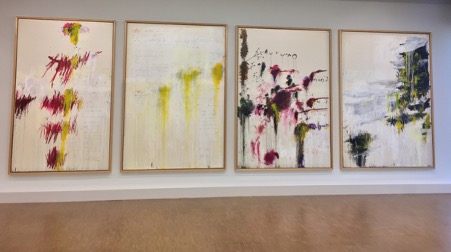
Quattro Stagioni – Cy Twombly
I remember seeing Canon’s The Circle of Life in Vienna. It wasn’t mounted to the wall. It sat in the centre of the room on an easel, a vortex on stilts. It doesn’t speak in loose terms or metaphors. The meaning of this painting is direct. I think that’s ultimately the point. The human condition is an inherently complex phenomenon; despite the fact we are living it. Breathing it. Feeling it. Canon’s genius here isn’t challenging society, institutions or the headaches that occupy surface level perceptions of what constructs identity. What this painting captures is the human condition.
Twombly abstracts Canon’s message. However, Twombly connects us with eternity. Equating the cycles of life to the seasons where we are no longer represented by ego. The cycles here are marked by birth, decay, renewal and death. We are connected to the rhythms of nature, how we build into the cosmos. Irrespective of who you are, you too are subject to the same cosmic rhythms. This is absolution, release.
These paintings do not tell us what the meaning of life is, they ask if we understand the meaning of life. Two questions; the first implies there is a direct object we are all in pursuit of – the wrong question. The second provides grounds for agency. That there is no unanimous object, but a pursuit that we are in the process of achieving – the right question.
These paintings transcend all the constructs that divide who we are as people. Identity, creed, class, religion. All of these constructs fall away. What we are left with is the expression of what it means to be human; the reality that we are all just going through it. That despite where you are in life, you too are vulnerable to triumph, decline, solitude.
Yet what these works ultimately reveal is that the substance of these cycles – the specific details, the narratives we construct around them is almost incidental. What matters is that we all move through them.
This is something I only began to understand after the last conversation I had with my grandfather.
There was no neat reconciliation in that moment, no summation of what we meant to each other. Just a final exchange; him at the end of his life in Bangkok, me at the beginning of mine in London. We were both lying down, speaking through a screen. The distance between us was not just geographical, but shaped by time, by experience. He had lived through his cycles; I was only just beginning mine.
I ended the call with a final term of endearment. There was no reply, only the shuttering off of facetime.
At the time, I thought of that moment as a kind of lesson. But over the years, it has come to feel more like an unfinished blessing. The conversations we had during my final year at university have gradually taken on new meaning. The infinity I once felt with him, that I have felt with very few people in my life, closed abruptly in that moment.
He stood at the end of one cycle; I stood at the beginning of many.
What I have come to understand is that he wasn’t trying to give me answers. He was trying to spare me from learning certain lessons the way he did – through repetition, through difficulty, through the slow recognition of patterns that only become visible in hindsight. And yet, despite that, I will still have to pass through my own versions of those same cycles.
That is what these paintings ultimately articulate. Not the specifics of our experiences, but their shared structure. The inevitability of movement through joy and pain, certainty and doubt. The fact that, regardless of where we are, we are all subject to the same underlying rhythms of life.
We may imagine our journeys as unique, even exceptional. But in the end, we are all moving through it.
And perhaps that is the closest we come to understanding what it means to live.